(reading time: 5 mins)
You’ve spent months perfecting your prototype. You’ve negotiated the unit price down to the cent. The manufacturer sends over the final contract, and right next to the price, there are three random letters: EXW. Or maybe it’s FOB. Or DDP.
You assume it’s standard legal jargon, sign the dotted line, and wire the deposit.
Fast forward three weeks: Your cargo is stuck at a port in Shenzhen, the supplier isn’t answering their phone, and customs is demanding a document you’ve never heard of. Worse? If that ship sinks, you might be legally liable for uninsured cargo sitting at the bottom of the ocean.
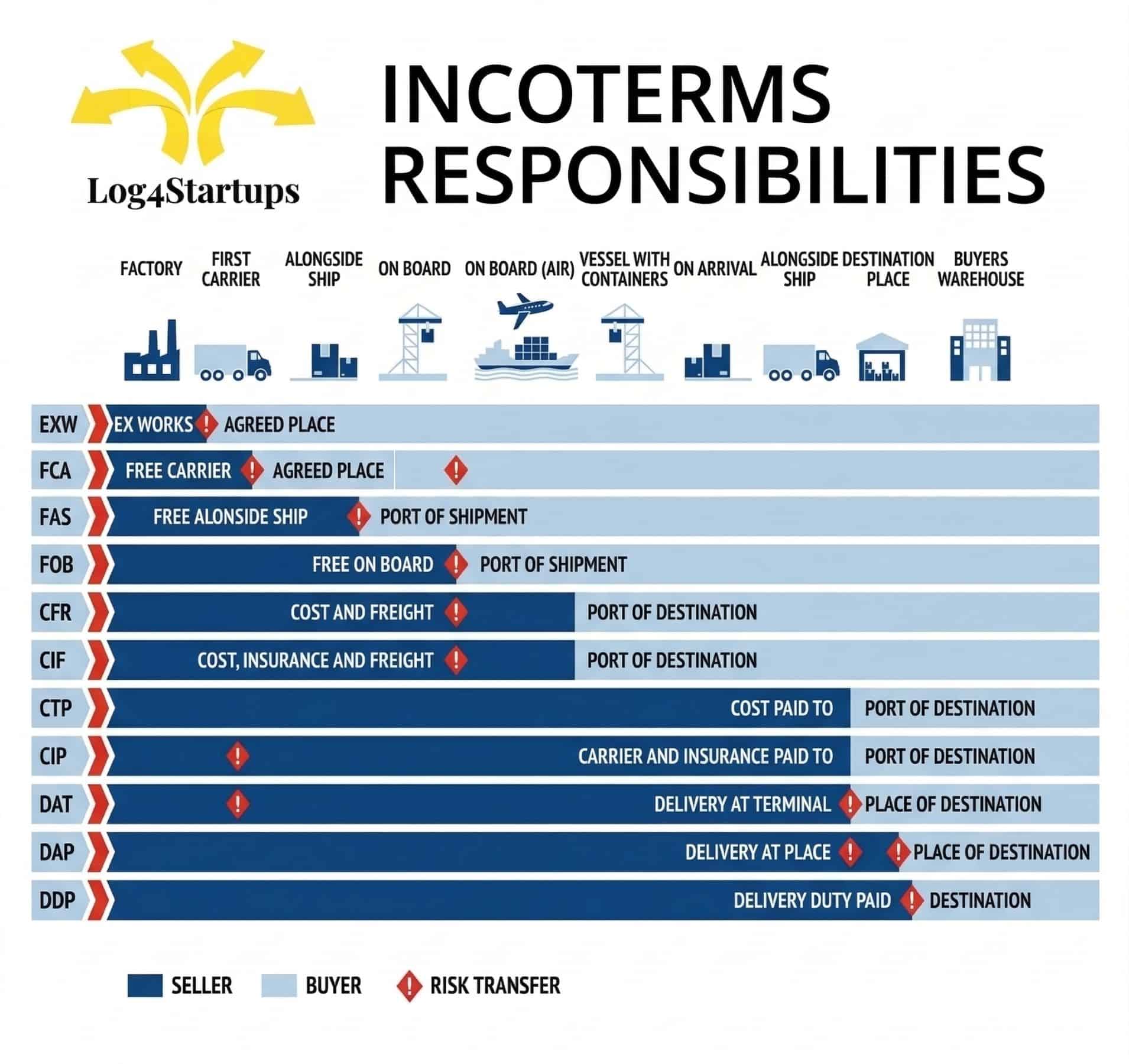
Welcome to the world of Incoterms (International Commercial Terms). While they look like alphabet soup, these three-letter acronyms are the absolute foundation of your supply chain. They act as a universal contract that defines exactly two things:
- Who pays for what along the shipping route.
- At what exact moment the risk (liability) transfers from the seller to the buyer.
Picking the wrong letters can destroy your margins or leave your startup exposed to massive risk. Here is the plain-English breakdown of the three most common Incoterms startups use, and the one you should actually be negotiating for.
EXW (Ex Works) — The “Do It Yourself” Trap
What it means: The supplier manufactures your product, packs it in a box, and leaves it on their own loading dock. That’s it. Their job is done.
The reality for founders: From the moment that box sits on the factory floor, it is 100% your problem. You have to hire a local truck in a foreign country, navigate their local export customs, get the cargo to the port, load it on a ship, and bring it to Europe. If the truck crashes on the way to the port in China, you lose your money.
The Verdict for Startups: Avoid EXW. Unless you have a dedicated, highly experienced logistics team on the ground in your supplier’s country, this places maximum liability and administrative headache on your startup from minute one.
DDP (Delivered Duty Paid) — The “Expensive Convenience”
What it means: The exact opposite of EXW. The supplier handles literally everything. They ship it, clear export customs, pay for the ocean freight, clear import customs in Europe, pay the VAT/duties, and deliver it straight to your garage or 3PL warehouse.
The reality for founders: It sounds like an absolute dream for a busy, bootstrapped founder, right? Wrong. That convenience comes with a massive, hidden price tag. Suppliers are manufacturers, not logistics experts. When they quote you an “all-in” DDP price, they are padding the shipping rate with a massive buffer to protect their own profit. Furthermore, if there is a delay at the port, your supplier will have zero urgency to fix it, and you will have zero visibility into where your inventory is.
The Verdict for Startups: DDP is fine for your very first 10kg sample box. But once you are shipping pallets or containers, DDP will quietly bleed your margins dry. You are paying a premium for a severe lack of control.
FOB (Free On Board) — The “Startup Sweet Spot”
What it means: The supplier handles the local transport and export customs in their own country, and they pay to get your cargo physically loaded safely onto the ship.
The reality for founders: The liability transfers to you the moment the cargo is “safely on board” the vessel. From there, you (and your European freight forwarder) take over the main leg of the journey and the import customs.
The Verdict for Startups: This is the gold standard for scaling e-commerce brands. Why? It gives you the perfect balance of control and cost-efficiency. You don’t have to navigate foreign export bureaucracy (the supplier does that), but you get to choose your own freight forwarder to negotiate the best ocean/air rates. It keeps your costs totally transparent and your margins protected.
The Founder’s Golden Rule for Freight
Never let your manufacturer dictate your logistics.
When you let the supplier act as your forwarder (like in DDP), you lose control of your runway. When you take on too much risk (like EXW), you expose your business to disaster.
For 90% of startups, FOB is the magic word. It allows your manufacturer to do what they do best (make products) and allows you to hire a dedicated logistics partner (like SME-Europe) to do what we do best: protect your cargo, optimize your routes, and fiercely defend your margins.
Next time you get a quote from a supplier, ask for the “FOB price”—then send it to your forwarder. The savings might just fund your next marketing campaign.